- Role
- Product designer, solo entry
- Timeline
- Five days, Oct 27–31, 2026
- Brief
- Civic by Design 2026 Figma Challenge: a noise-complaint service where New Yorkers get closure
- Built with
- Figma Design, Make, Motion and Slides, with Claude
- Status
- Submitted Oct 31, 2026, in all three tracks. Winners are announced Nov 6.
TL;DR
What should 311 say back after you report noise?
The problem
Most people who report noise in New York never hear what happened. When they do, it's often one line saying officers found no evidence.
What I made
Chorus sorts each report into one of four paths, tracks it like a delivery, explains the result in plain words, and asks the next morning if the noise stopped.
My part
All of it, solo: the research, the service, the brand, the posters and the motion. I built the Figma work and the Make prototype with Claude.
01The problem
Most noise reports end with one unexplained line
The Civic by Design 2026 Figma Challenge asked for a noise-complaint service where New Yorkers get closure. I entered all three tracks: the brand, the service and the motion.
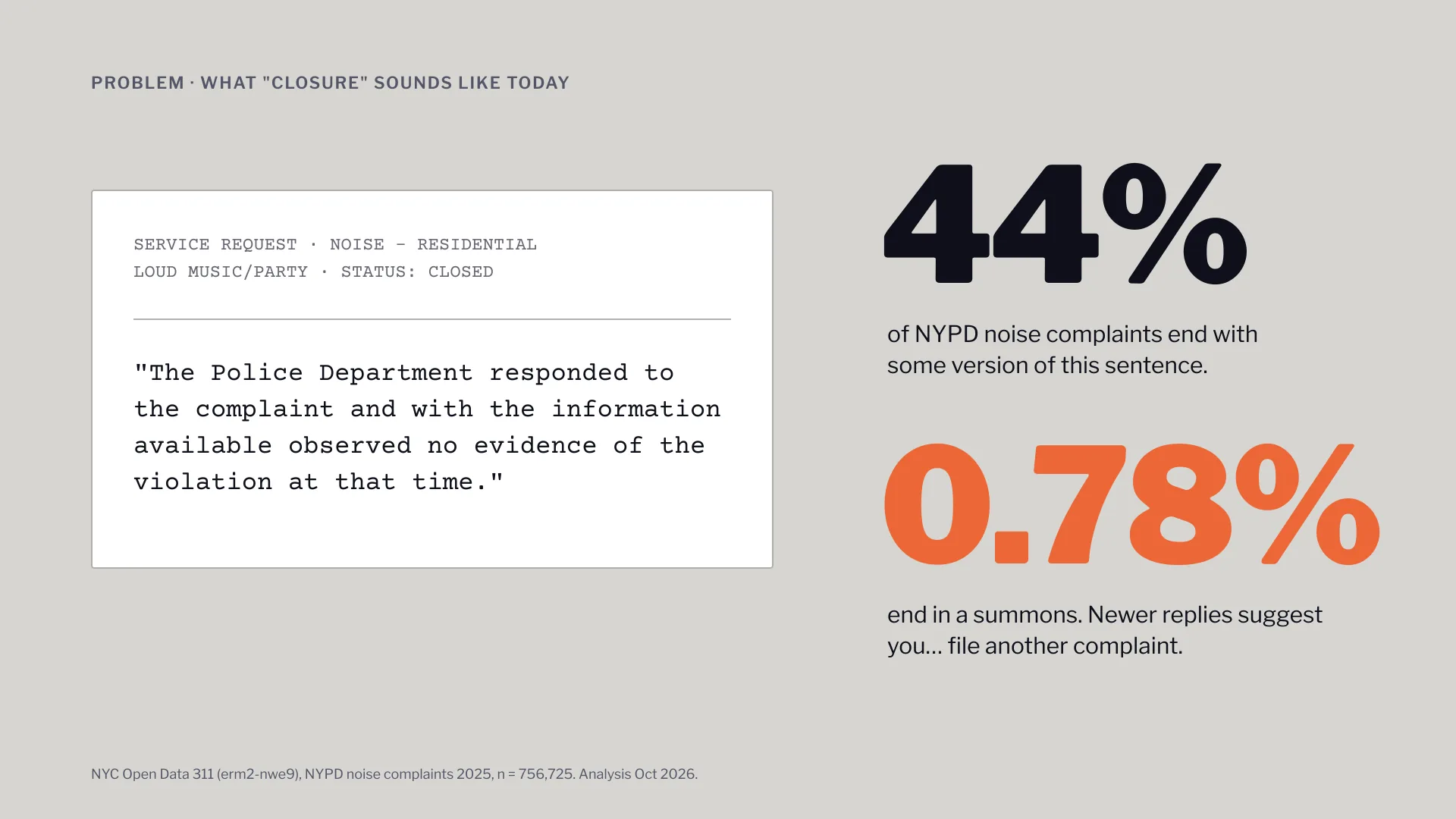
I don't live in New York, so I started with the city's own 311 data. When a case does come back, the answer is often a single sentence: officers "observed no evidence of the violation." Nobody explains what that means, or what you can do next.
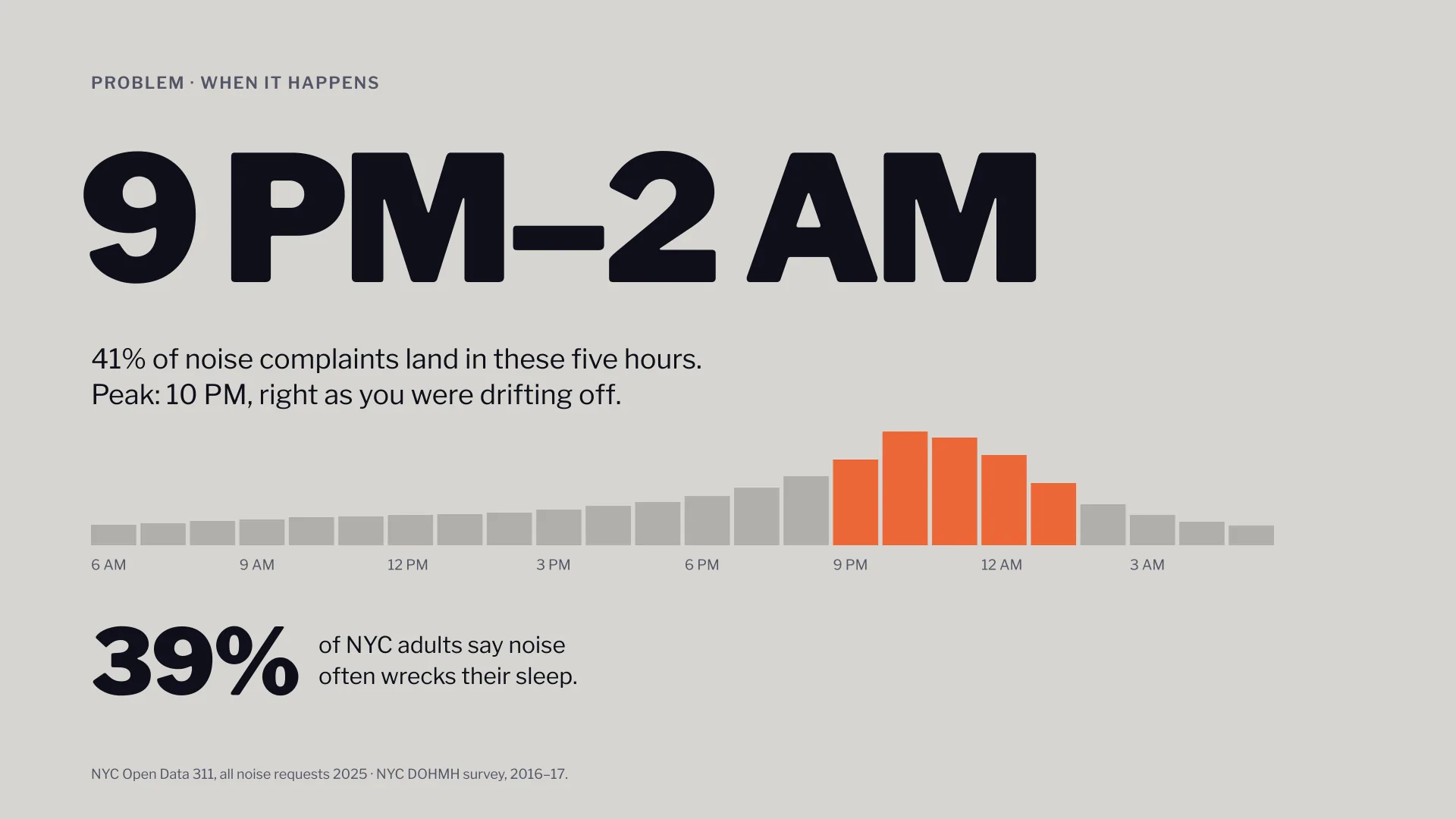
The data also showed when and who. Four in ten complaints come between 9 PM and 2 AM, when people are trying to sleep. And 91% of noise complaints go to the NYPD, whether it's bass through the wall or a block party, so the answer is almost always a police officer at a neighbor's door.

Civic by Design 2026 · Figma Challenge
An online challenge run with AIGA, with the NYC Office of Technology as civic partner. Individual entries, across three tracks: Branding & Communication; Service, Strategy, UX & UI; and Creative Direction & Film.
NYC Open Data, 311 service requests (erm2-nwe9)
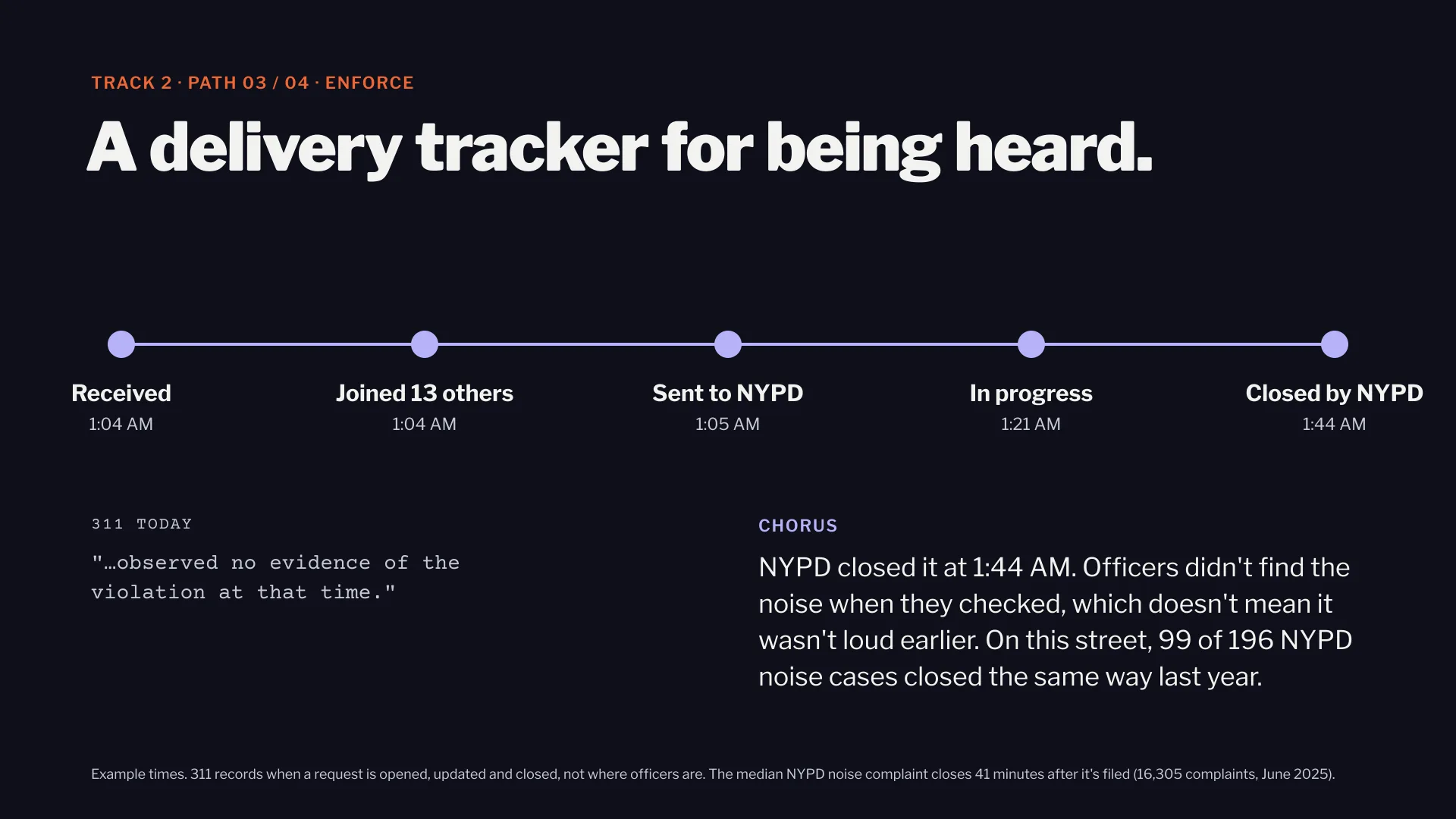
All noise requests in 2025 (833,000), analyzed in October 2026: 41.4% came in between 9 PM and 2 AM, and the peak hour was 10 PM. On W 108th St, 99 of the 196 NYPD noise cases closed in the past 12 months ended with "no evidence" (queried Oct 30, 2026; the prototype fetches this live, so it moves).
Other sources
Sleep: NYC DOHMH survey, 2016–17. Who responds: BuzzFeed News, 2018, and the Community Service Society of New York's 311 data analysis.
02The service
Every report gets an ending you can see
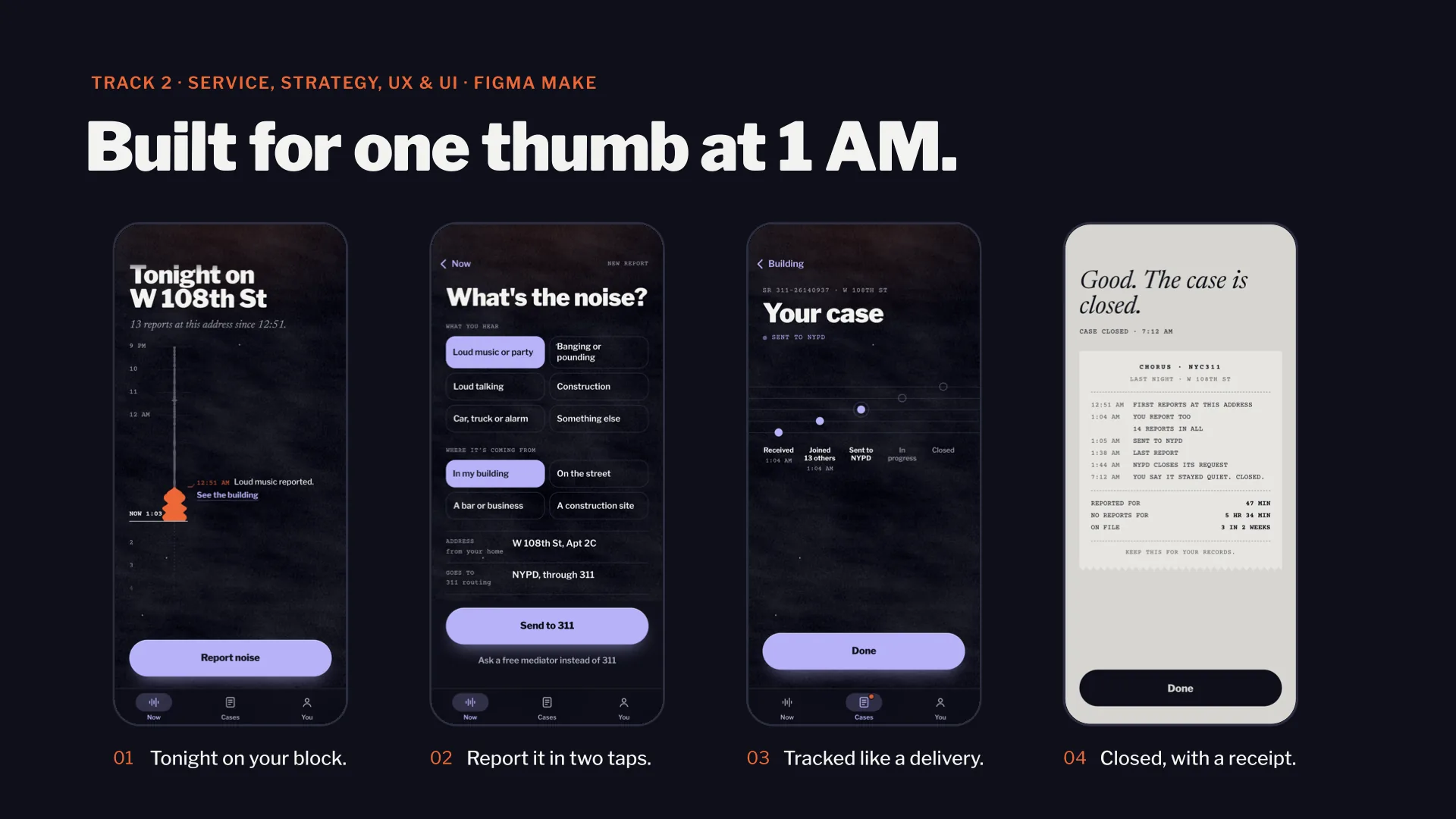
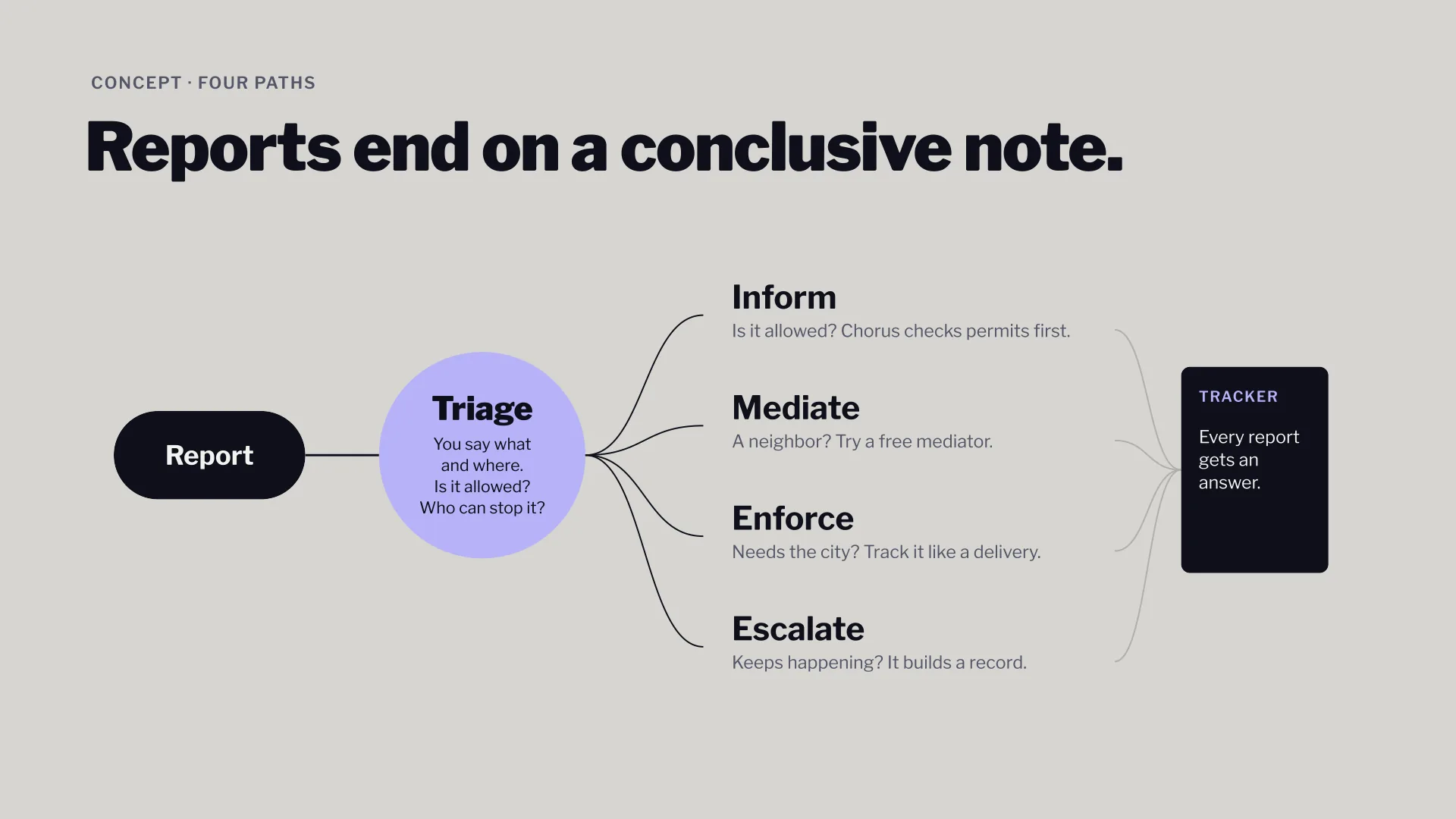
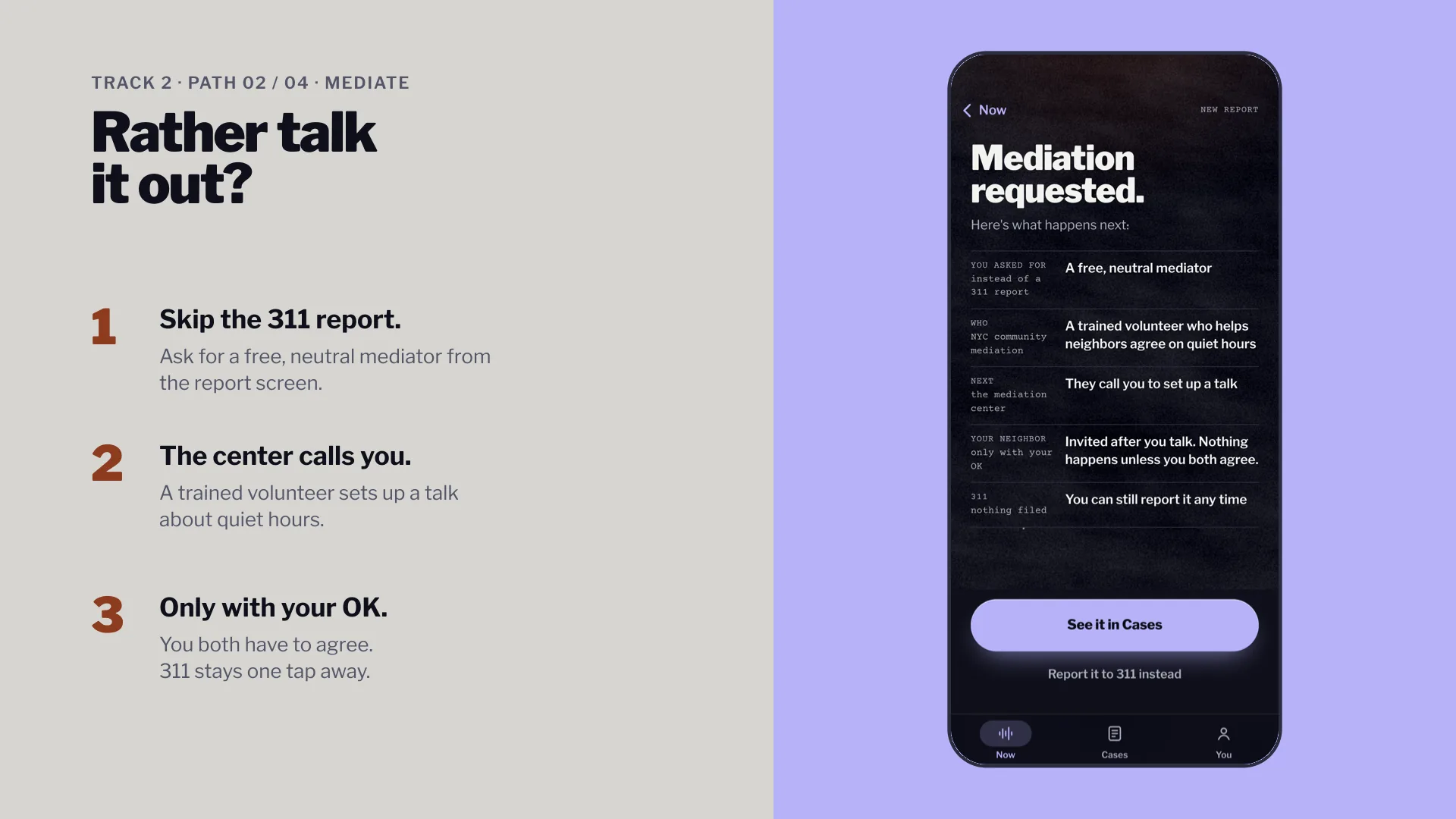
Chorus sits on top of 311 as it runs today. Reporting takes two taps: what you hear and where. Then Chorus sends the report down one of four paths. Construction gets checked against city permits before anything is filed. A neighbor you'd rather talk to can go to a free community mediator. Everything else goes to 311, and you follow it step by step. When neighbors report the same address, their reports add up to one case.
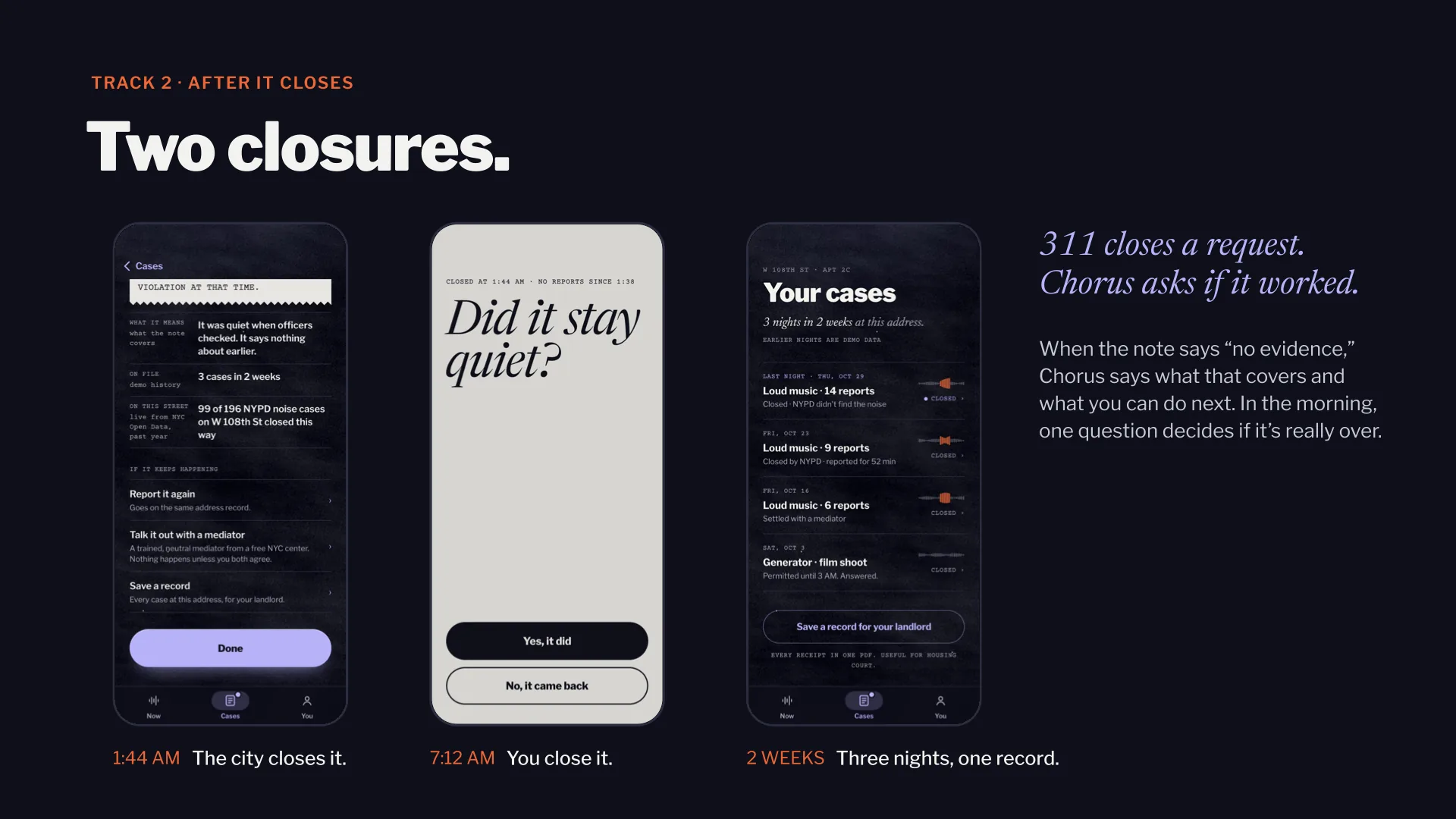
When the case closes, Chorus explains the result and offers what's next: report it again, ask for a mediator, or save a record for your landlord. The next morning it asks one question: did it stay quiet?
Made for one hand at 1 AM
Most noise complaints come in late at night, so the app is dark and works with one hand. I built the prototype in Figma Make, and it pulls live 311 counts for the block. Every claim in it shows where it came from. The demo plays one night on W 108th St in about a minute, from a 1 AM report to the 7 AM check-in.


Two closures
311 closes a request. Chorus asks if it worked. When the note says "no evidence," Chorus explains what that covers and what you can do next. The city can close a case, but only you know if the noise stopped, so the next morning one question decides if it's really over.
Every case at the address stays on file. After a few nights, you can save them as one record for your landlord.
03The brand
A logo that starts loud and ends in harmony
The name comes from the idea that one report is easy to dismiss, and a whole block reporting together is hard to ignore. The mark is a jagged waveform that settles into a chord. The type gives each speaker a voice: Libre Franklin says what happened, Newsreader italic is Chorus talking to you, and Courier Prime is the city's own words.
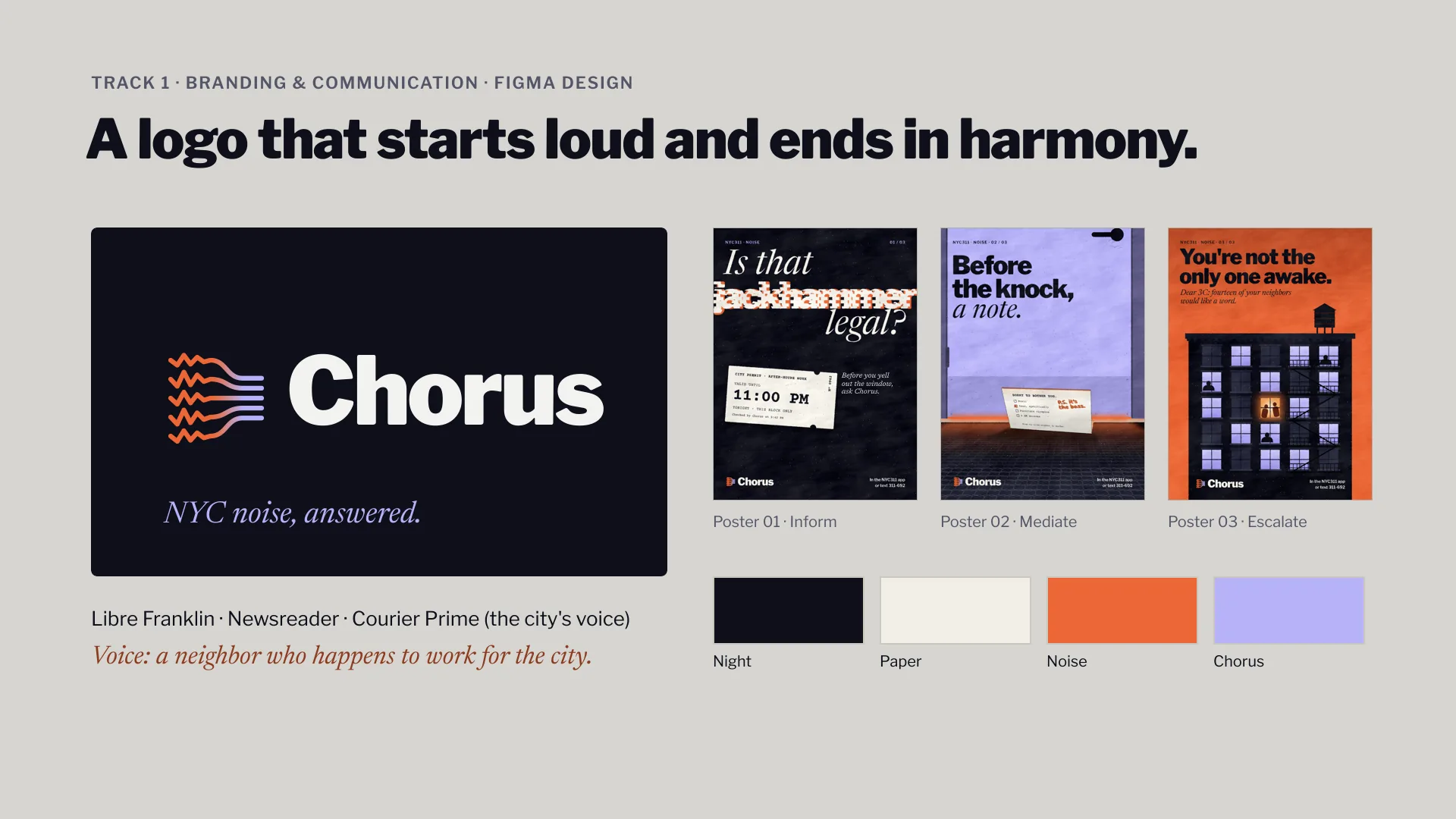
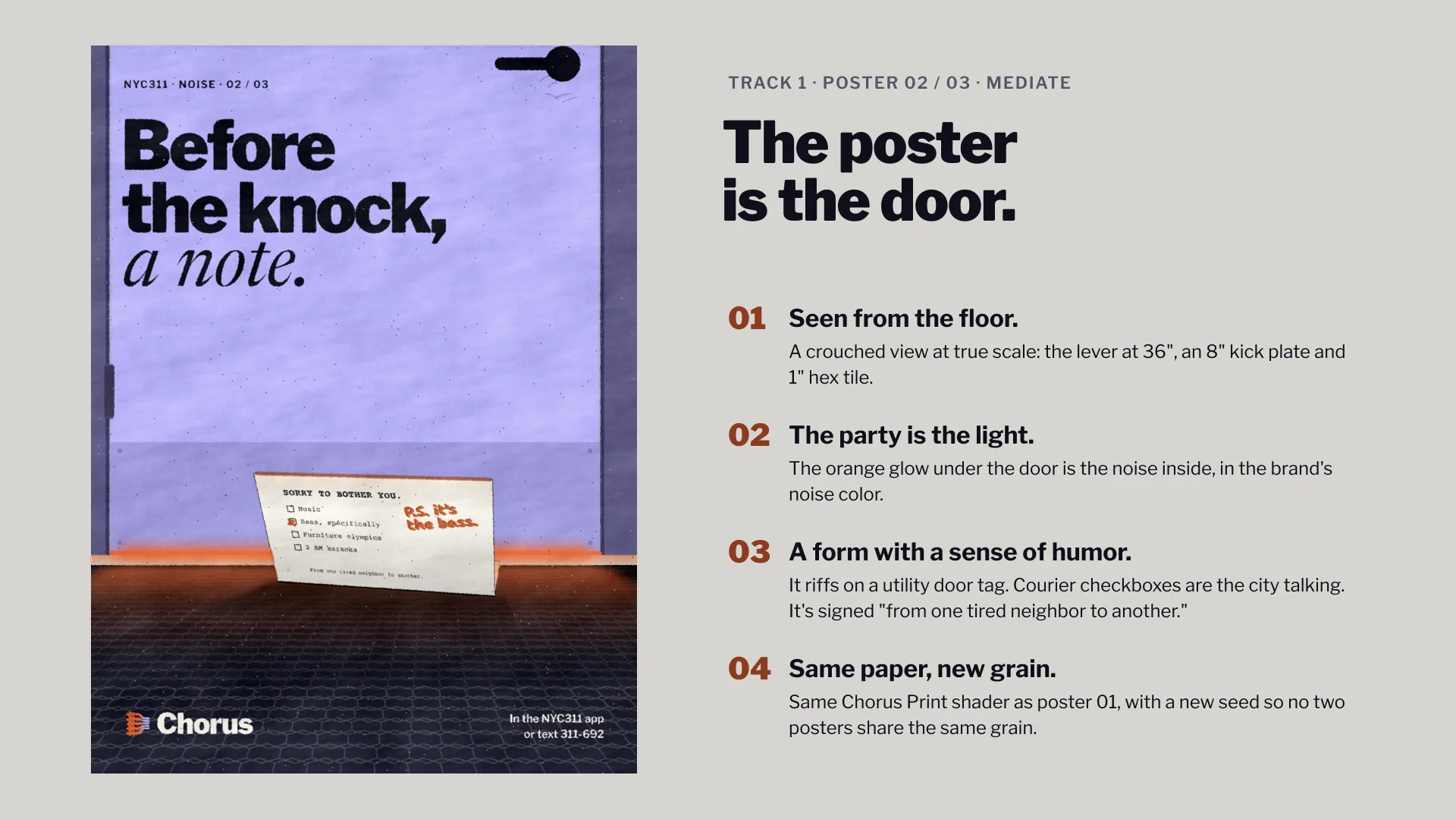
One poster for each path
Each poster answers a question people ask at night, in a city voice with some humor. All three share a print-texture shader I made in Figma, so they read as one series.


04Motion
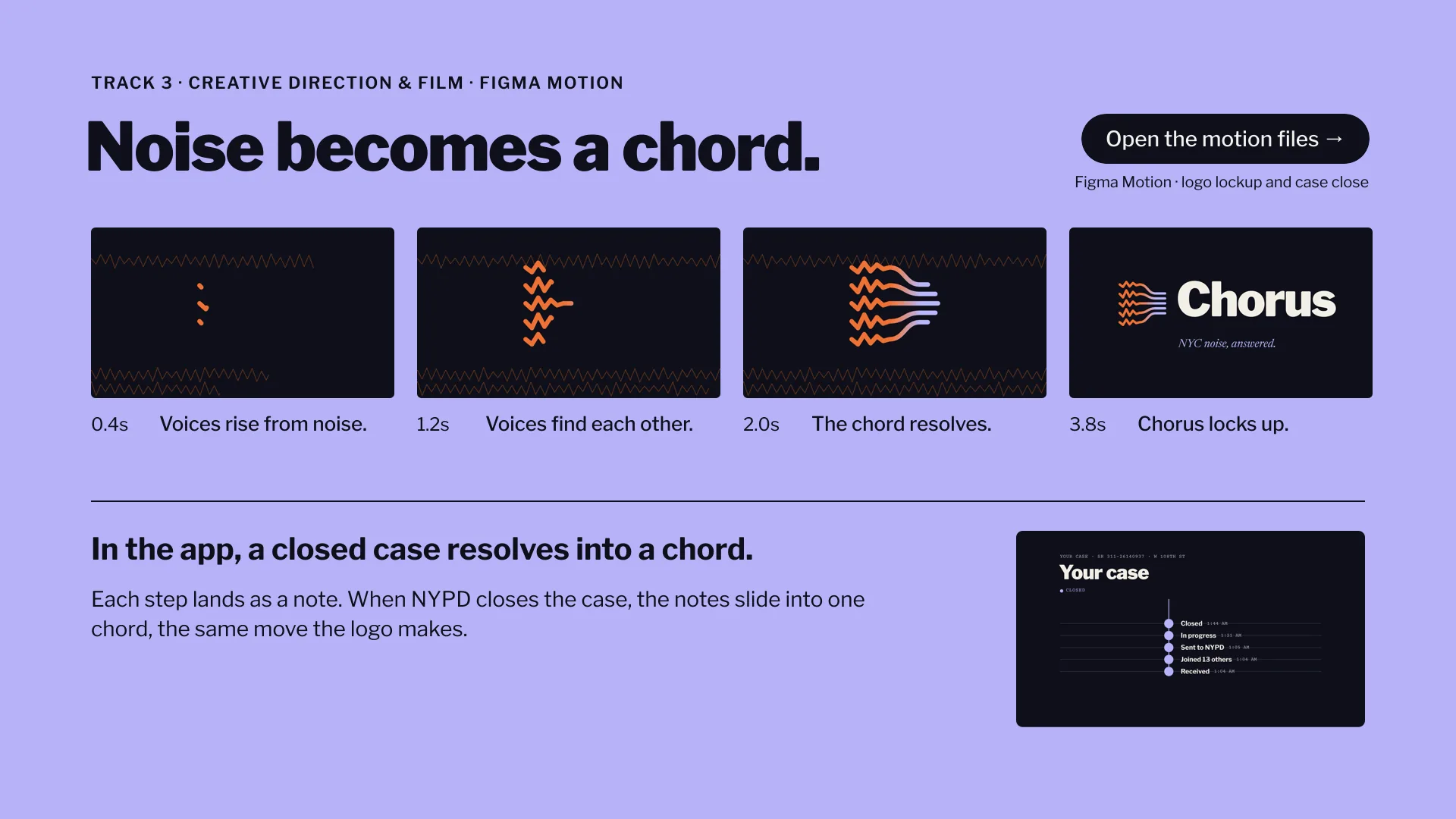
Noise becomes a chord
In Figma Motion, the logo starts as scattered noise, the waves find each other, and the chord locks into the wordmark in under four seconds. The app uses the same move: each step of a case lands as a note, and when the case closes, the notes slide into one chord.
05The pilot
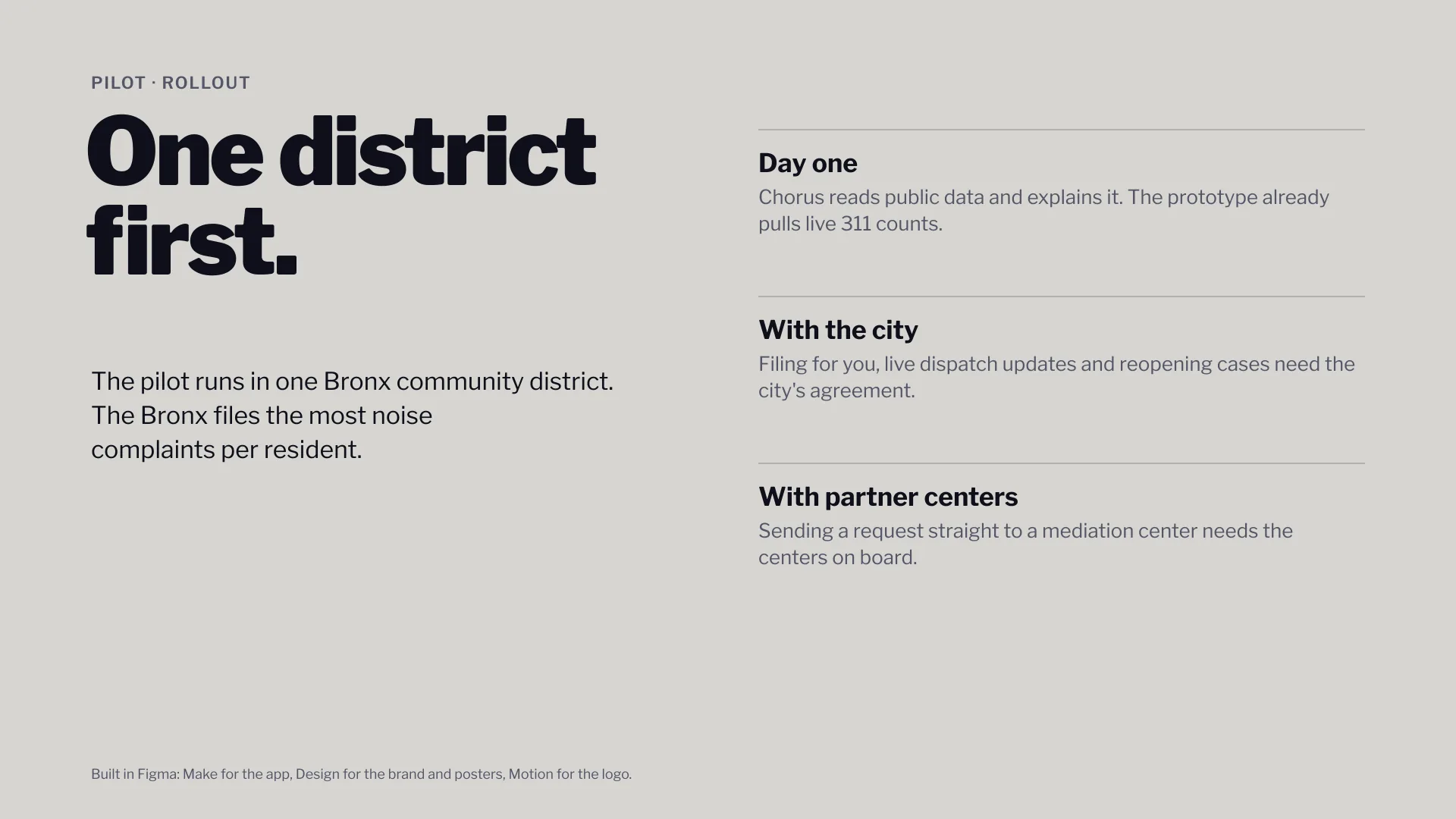
Start with one district and data the city already has
Chorus works with 311 as it runs today. Everything it needs already exists: 311 requests and how they closed on NYC Open Data, the city's permit data, free community mediation, and 311's support for more than 175 languages.
The pilot would run in one Bronx community district, because the Bronx files the most noise complaints per resident. On day one, Chorus reads public data and explains it, which the prototype already does. Filing for you, live dispatch updates and reopening cases would need the city's agreement. Sending requests straight to a mediation center would need the centers on board.
What I'd measure
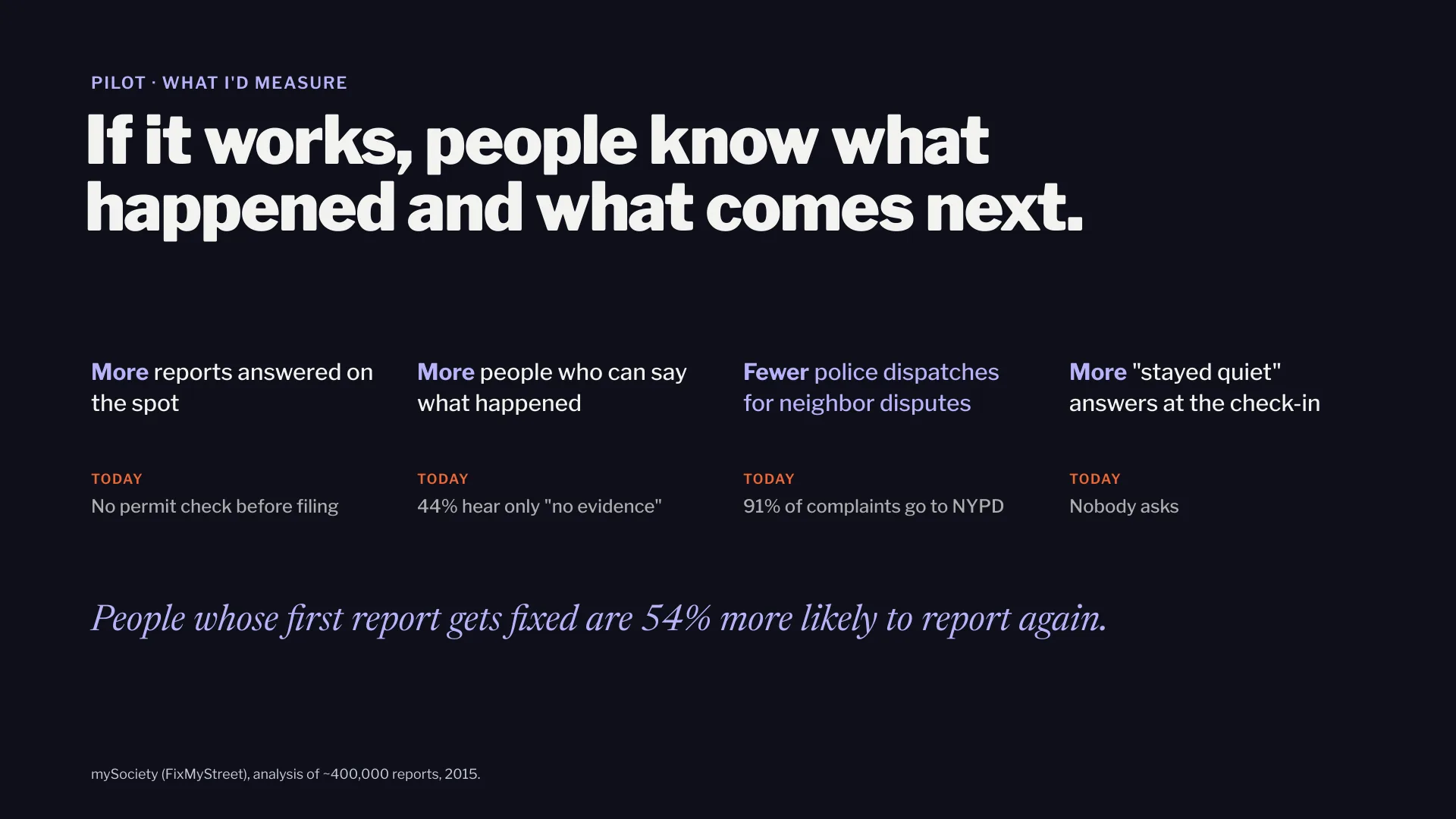
If it works, people know what happened and what comes next. I'd track four things against today's baseline: more reports answered on the spot (today there's no permit check before filing), more people who can say what happened (today 44% hear only "no evidence"), fewer police dispatches for neighbor disputes (today 91% go to the NYPD), and more "stayed quiet" answers at the check-in (today nobody asks).
None of this has been measured yet. These are the numbers a pilot would need to move.
mySociety (FixMyStreet), 2015
An analysis of about 400,000 reports found that people whose first report gets fixed are 54% more likely to report again.