- Role
- Product designer, solo
- Timeline
- Competition: six days, Oct 15–21, 2026. Redesign: Oct 23–Nov 7
- Brief
- Design for a specific group of people. Theme: storytelling.
- Built with
- Figma, Claude Code (SwiftUI), Codex, Perplexity
- Testing
- 3 moderated sessions on the submitted version
- Status
- Concept and working iOS prototype
TL;DR
How can people who live apart share a meal?
The problem
A group order in a delivery app goes to one address. Friends in different cities order on their own, and their food lands whenever it lands.
What I made
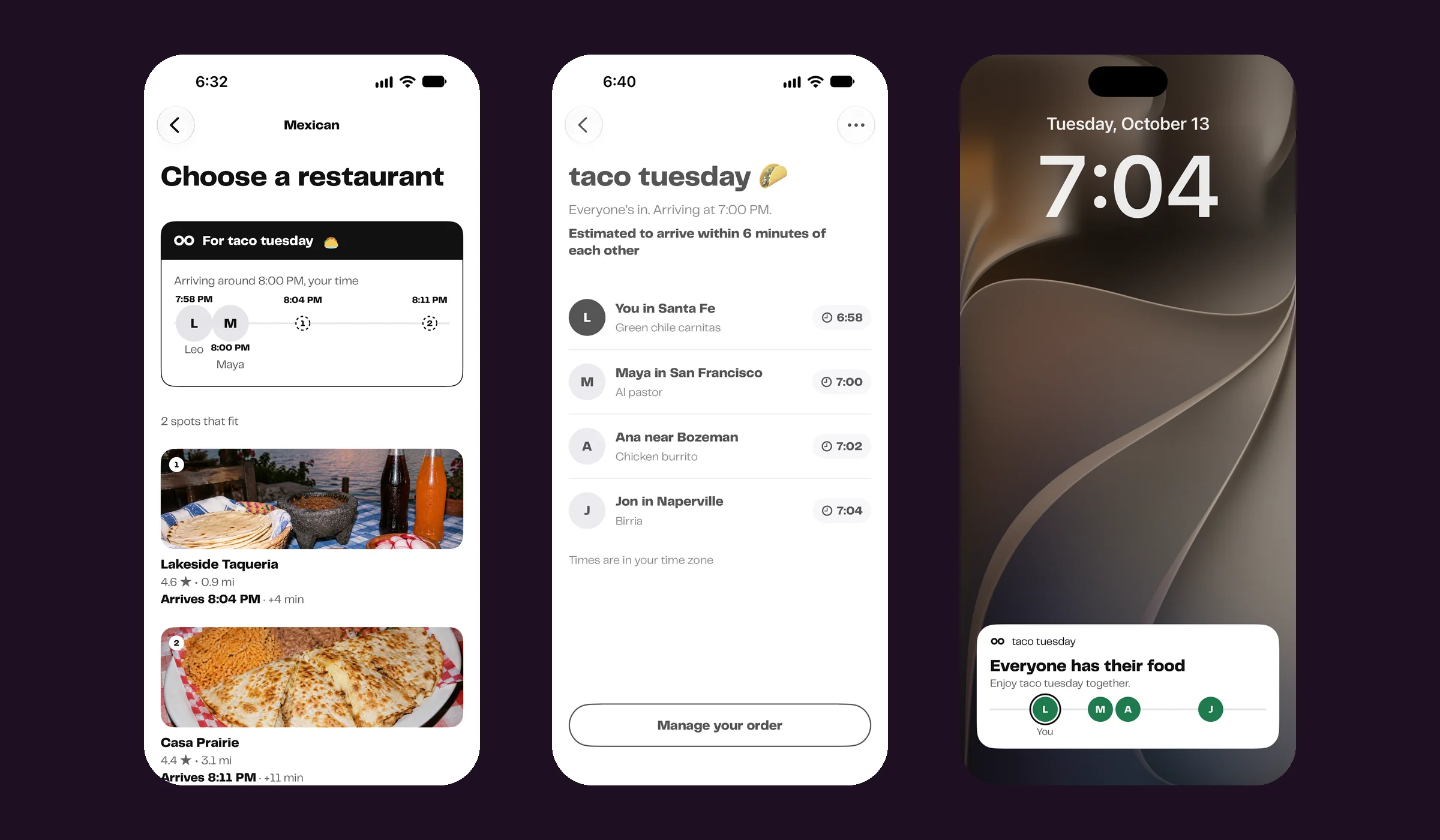
menoo, a mode inside a delivery app. The host picks a kind of food and a time. Everyone picks a restaurant near them and their own dish, and menoo times each order so the food arrives close together.
How it got here
I submitted a separate app with a shared room in six days. After three user tests and the organizer's feedback, I rebuilt it from zero and kept one rule: everyone eats the same kind of food.
01The problem
Friends who move apart stop eating together
The brief for the SVSD design competition, run by Naheel Jawaid, asked for a product a specific group would love, even if others hated it. I had six days to go from the brief to a working prototype and a presentation video. I picked close friends and family who used to eat together and now live in different cities.
Many of them already eat over video calls. Each person orders or cooks on their own, and the food shows up at different times. As far as I could find, a group order in the big delivery apps goes to one address, so there's no way to plan one meal for people in different cities.
I think eating the same kind of food at the same moment brings people closer. With no time for interviews, I used Perplexity to find research on that belief. Lab studies support it, and a 2022 study of lunches over Zoom found no effect between strangers, so I treat it as my bet and would measure it.
I also checked how delivery apps time orders. At one restaurant on a Friday at midday, scheduled delivery offered 20-minute windows, and a standard order gave a 10-minute estimate. A 20-minute window could let four friends' food land 20 minutes apart, which shaped how menoo times orders later.
SVSD design competition 2026
Brief released Oct 15 at 7:00 AM PT. Submission due Wednesday, Oct 21 at 11:59 PM PT: a working prototype and a presentation video.
Wang, Kubota & Inoue, Frontiers in Computer Science, 2022
In remote dinners for three, eating the same meal led to more synchronized eating and a stronger sense of togetherness.
Woolley & Fishbach, Journal of Consumer Psychology, 2017
Strangers who ate similar food trusted and cooperated with each other more.
02What I submitted
In six days, I designed the wait
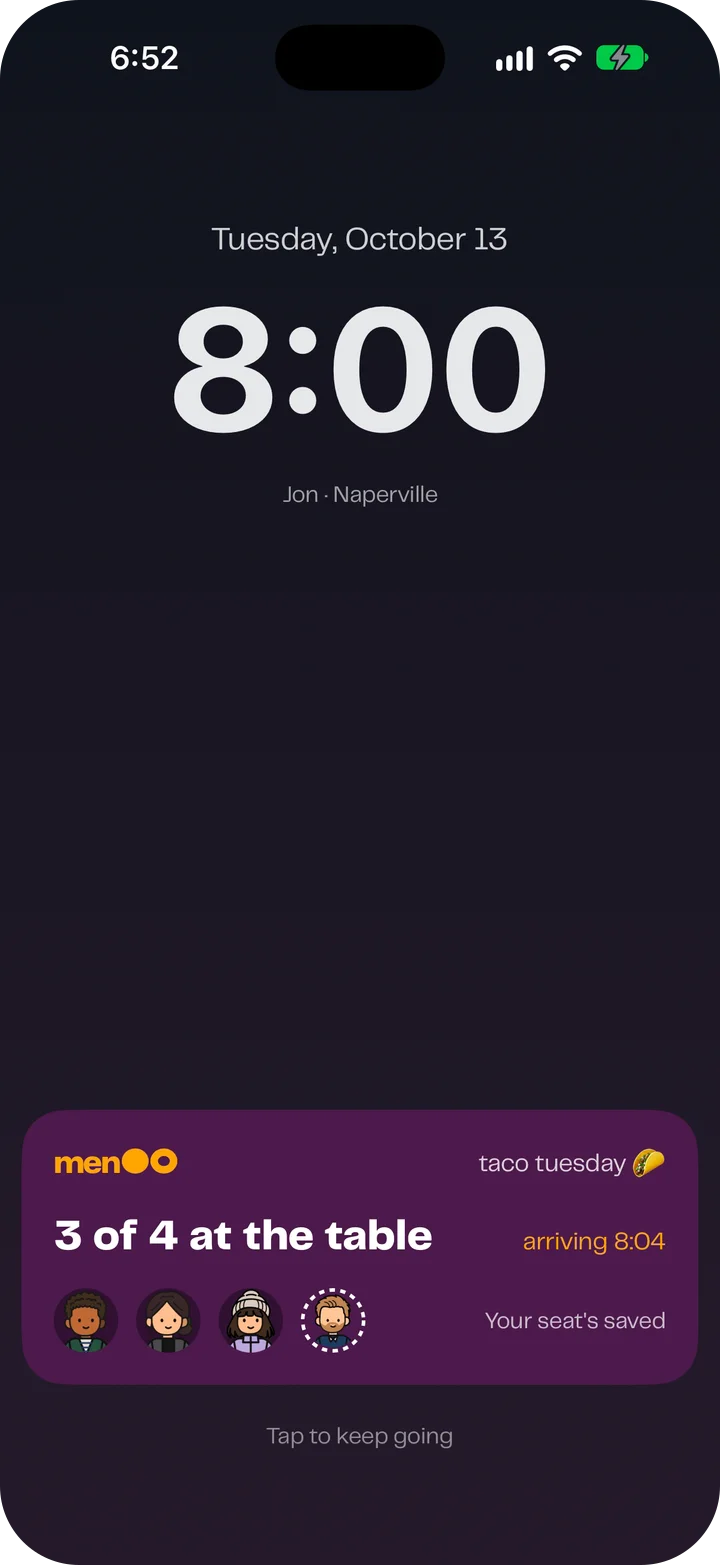
The version I submitted was a separate iOS app for up to eight friends. The host named the meal, AI suggested a cuisine (taco tuesday became street tacos), and menoo found a restaurant near each friend. Paying was the ticket into an illustrated room, where ink-line avatars waited and walked to the table as their food arrived. When the last chair filled, menoo handed off to FaceTime.
I built the Figma system and an avatar parts kit, and directed Claude Code to build a SwiftUI prototype with a Live Activity on the lock screen.
03Testing
Three people tried what I submitted
After the competition I ran three moderated sessions over Zoom on the submitted Figma flow, on Nov 2 and 3. Lucia, Andrea and Ferrara each have someone close in another city or country. They joined a friend's invite as a guest, then I asked about the room and the one-cuisine rule. All three agreed to be recorded and quoted.
- 3 of 3
- joined without help, in a median of 54 seconds
- 3 of 3
- would join for tacos on a night they wanted sushi
- 2 of 3
- already eat or cook with someone over a call
- 3 of 3
- named someone abroad, and menoo only works in one country
Andrea and Ferrara called it a compromise before I did. Andrea put it simply: “next time will be sushi.”
The organizer said it felt forced, and the tests showed me where
The competition's organizer wrote that menoo asked too much of people, that eight people was a lot, and that a delivery company would care about how it grows. In the sessions, Lucia called the room “the waiting zone” and asked for games in it. I read that as a sign the wait was too long. Ferrara's first worry was timing.
So I listed every moment where the design asked people to change what they already do. There were about seven: one cuisine, up to eight people, a new app with linked delivery apps and an avatar, about eight host steps before ordering, no call until every chair filled, food going cold while the last person waited, and paying to get in.
I also went back to the testers and asked how long they would keep an invite open as hosts. Lucia said 20 minutes, and Andrea and Ferrara said 15. An unplanned invite in the redesign stays open for 15 minutes.
Limits
Three people I recruited, guest path only. Their answers are about the submitted version, and the redesign hasn't been tested with people yet.
04The redesign
I kept one opinion and removed the rest
Everyone eating the same kind of food stayed, since all three testers said they'd go along with it. The rest changed to fit what people already do.
| What I submitted | After the redesign |
|---|---|
| A separate app | A mode inside the delivery app |
| Two to eight people | Two to four |
| A room with avatars | A plan with each person's status |
| A call after everyone sits | People call however they already do |
| Designing the wait | Shrinking the wait |
| Pay to enter | “I'm in,” with nothing charged until someone else joins |
| AI suggests the cuisine | The host picks the category |
| The late guest decides when everyone starts | The plan updates and asks nothing of the late person |
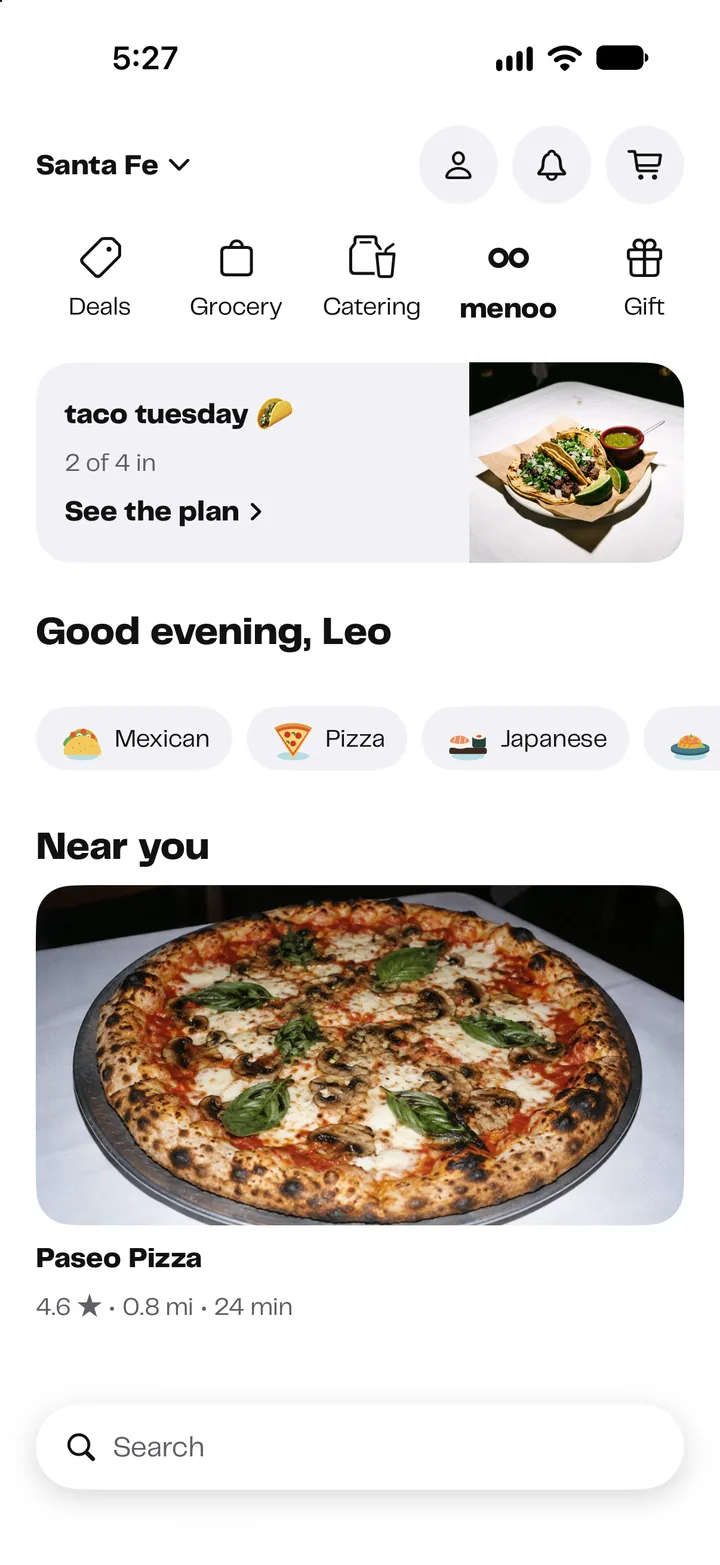

menoo moved inside the delivery app
Restaurants, arrival estimates, addresses and payment already live in the delivery app. A separate app would need a way to place those orders, and I couldn't find a public one. One friend who won't install a new app also breaks the meal for everyone.
Inside the app, an invite to a friend without an account becomes a sign-up. menoo stays black and white so it can take on any delivery app's colors and type, and its screens name no app.
05How it works
The host picks the food and the time
Leo invites up to three friends and sees the time in each friend's zone. He picks a cuisine from the categories the app already has and names the night. Everyone else picks their own restaurant and dish.
menoo sorts restaurants by when their food can arrive
Jon sees spots near Naperville, each with an estimated arrival next to Leo's and Maya's. menoo holds each cart and places it as a standard order timed by that restaurant's estimate, so the food lands close together. When the cuisine isn't near someone, like Ana outside Bozeman, menoo shows similar options and she chooses.
AI in the product is a design spec
In the prototype, matches, estimates and delays are scripted. The spec gives AI three jobs: predict when each order will arrive and time it, find similar options, and spot a delay early. It never picks the cuisine, the restaurant or the dish.
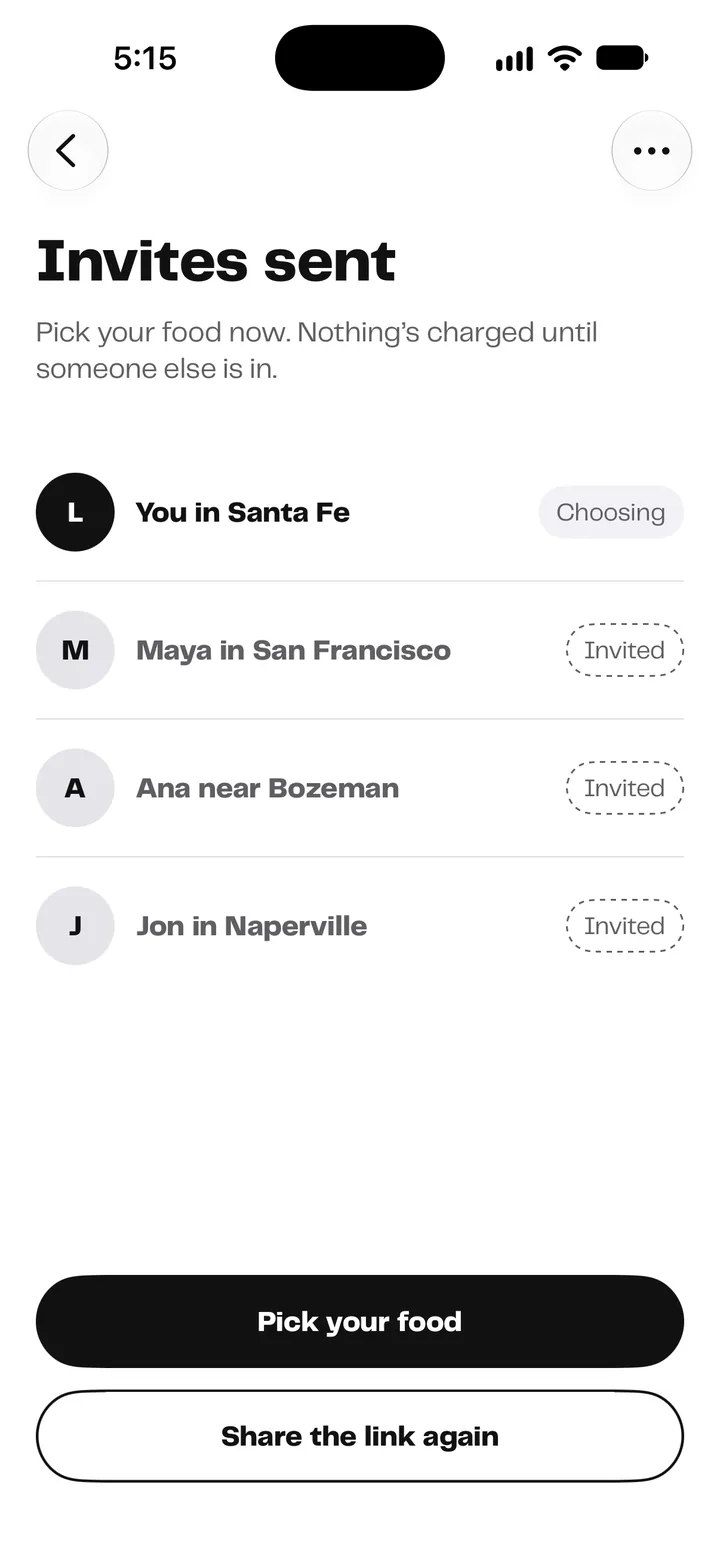
Saying “I'm in” costs nothing until someone else joins
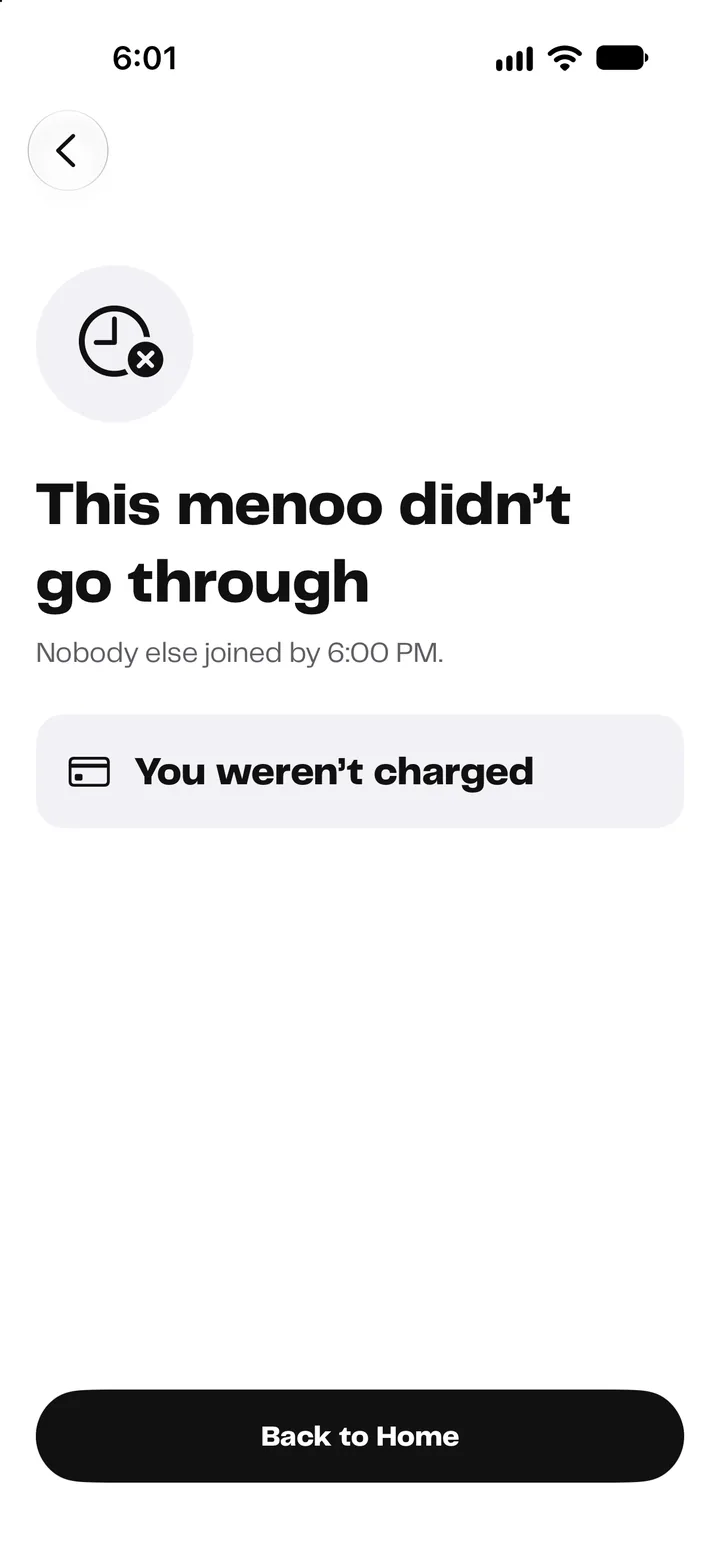
This was the hardest rule to decide. People often wait to see others commit before they do. So saying “I'm in” sets your order, and the time locks once a second person joins. Orders go in, and people are charged, when everyone has joined or the invite runs out, and only if at least two people are in. If nobody joins in time, the menoo lapses like a missed call.
Granovetter, American Journal of Sociology, 1978
Threshold models: many people decide to join once they see enough others have.
When food runs late, menoo asks nothing of that person
In the version I submitted, the late friend decided when everyone started. That put pressure on someone who had done nothing wrong. Now the plan updates for everyone, names no cause and asks nothing of Jon. Friends talk in their own chat.
Green only means delivered, and a late order turns amber. Every status pairs a word and an icon with its color.
Contrast check
All text meets WCAG AA. A check of 924 text layers found the lowest ratio at 4.97:1.
Anyone can start the next one
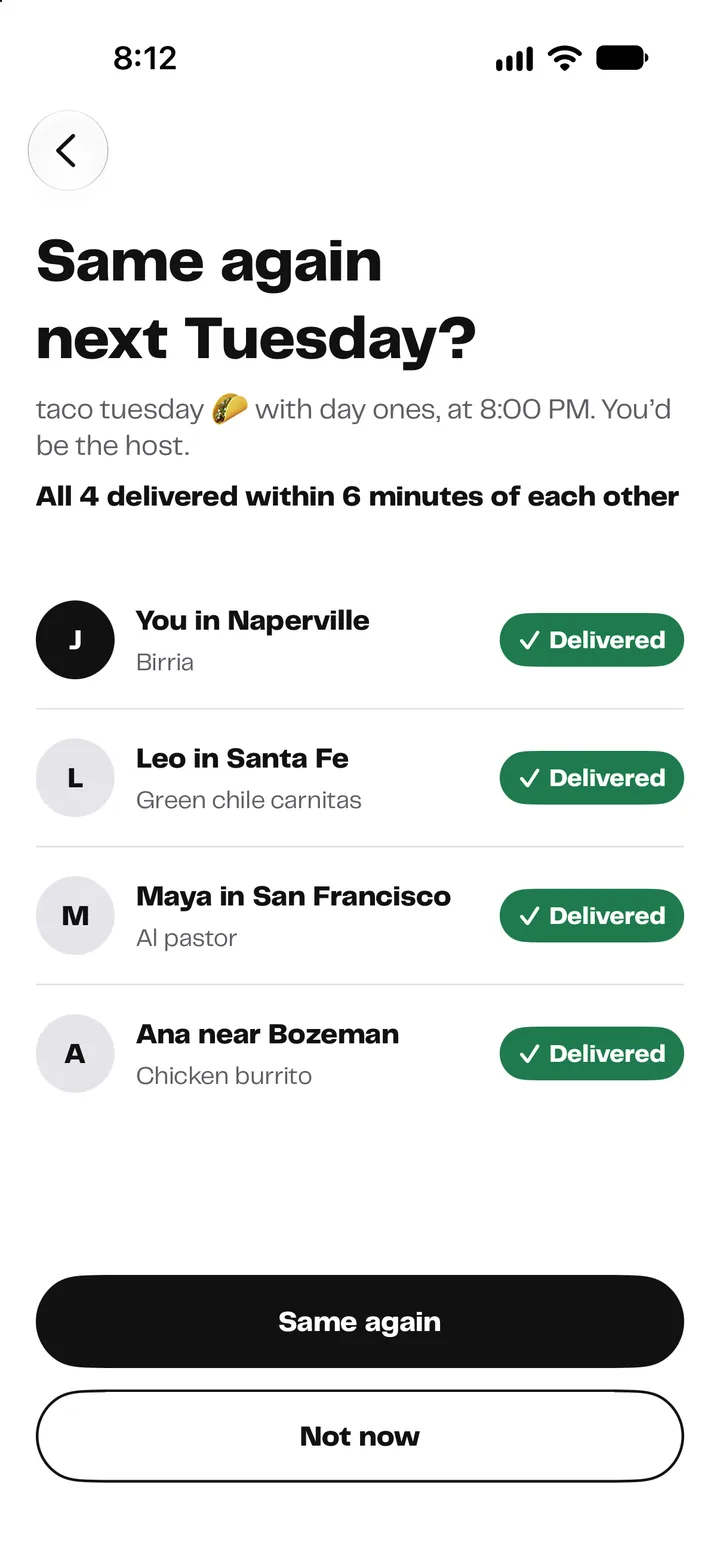
After the meal, the next time someone opens the app, menoo offers the same plan for next week. Whoever taps it becomes the host, so a friend who signed up just to join can start the next menoo.
06AI in the process
Where I used AI, and how I checked it
| Stage | What AI did | How I checked it |
|---|---|---|
| Research | Perplexity found academic sources. Claude summarized public delivery-app help pages. | I asked for each paper's contribution and limits and kept those limits in my claims. I checked the summary against the pages. |
| Ideation | Claude pressure-tested the logic. Codex, kept apart from my design work, was a second reviewer. | I went back to the research, and asked testers whether they'd use menoo. |
| Design | Claude, through the Figma MCP, applied my copy and layout changes across every screen. | I reviewed each change in Figma. |
| Prototype | Claude Code built the SwiftUI app and its Live Activity, which run in the iOS Simulator. | I compared it with the Figma screens and tapped through every flow. |
| Testing | Claude cleaned the transcripts and listed every behavior the design asked people to change. | I decided what to keep. |
Two catches of mine: AI wrote “Matched to Leo and Maya” and named one restaurant, which made it look like menoo chose for Jon. It now says “Your options are ready.” I also noticed a missing back button. An audit found 15 screens without one, and fixing them showed nothing led back to an active plan, so the plan now shows on Home.
07What's next
If it shipped, here's what I'd measure
- Arrival gap
- First to last delivery within 15 minutes. The 6 minutes on screen is a scripted target.
- Completion rate
- Share of menoos with two or more orders.
- Join rate
- Share of invited guests who join in time.
- New to the restaurant
- Guests ordering from that restaurant for the first time.
- Repeat rate
- The same group starts another menoo within 30 days.
- Orders per menoo
- Where a group order is one order, one menoo can be up to four.
What I learned
Coming up with ideas was the easy part of menoo. The hard part was scoping them into something a team could build, inside a business with real constraints: a delivery app that wants new customers, restaurants that want more orders and drivers who want more deliveries. So I cut the room, the avatars and the eight-person table, and spent most of the redesign on what happens when someone is late, drops out, never replies or sees their total go up.